

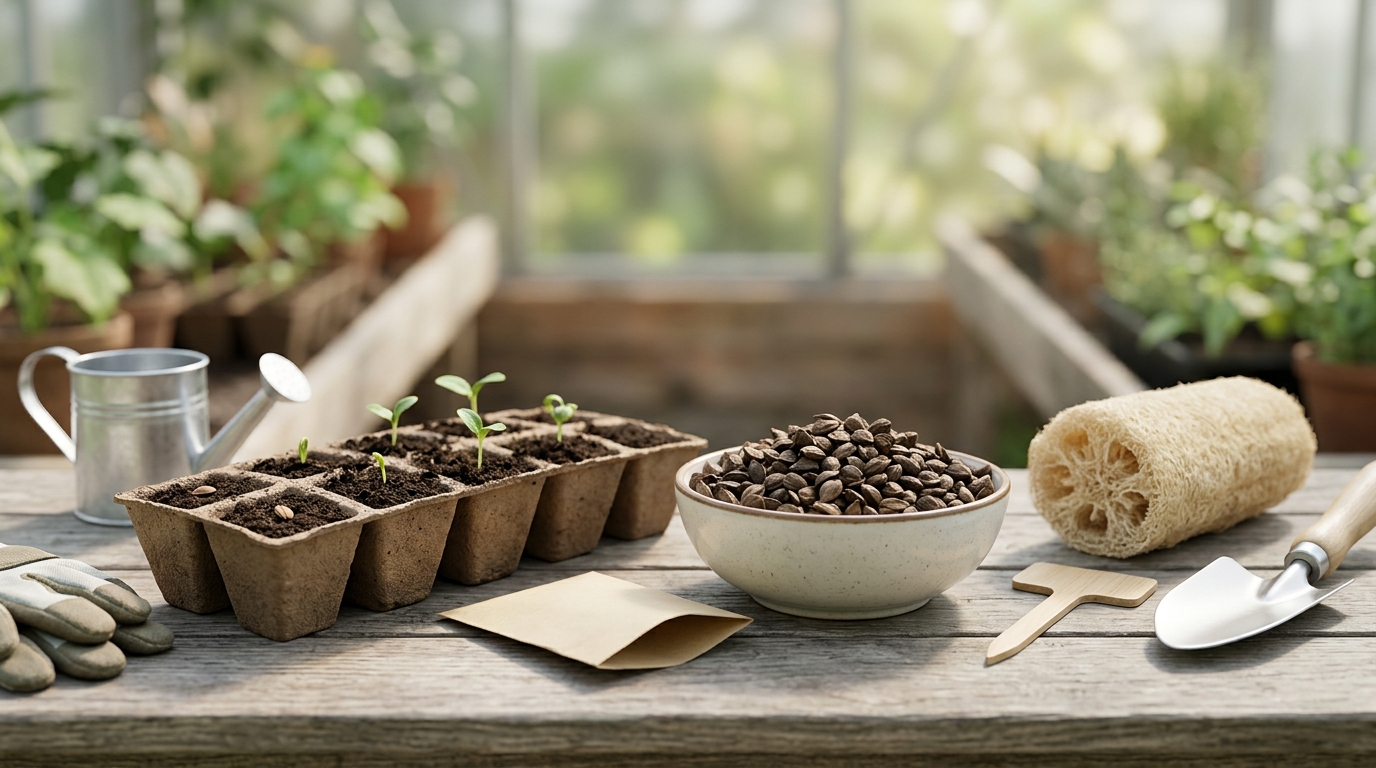
Growing your own sustainable bathroom sponges begins with acquiring healthy, viable seeds. Many home gardeners struggle with slow sprouting or low germination because loofah gourds require specific warm-season treatment that standard garden crops do not. A single healthy vine yields 5 to 10 durable sponges, making the initial investment in premium seed stock highly rewarding for eco-conscious households.
Understanding the difference between varieties and sourcing them from trusted growers ensures your garden produces thick, fibrous sponges. Starting seeds indoors early is essential because these tropical vines demand 150 to 200 frost-free days to mature fully. Mastering seed preparation, thermal germination, and early seedling care transforms a tough, dark seed coat into a thriving, productive vine.
Where to Buy Premium Loofah Seeds online and In-Store
Finding high-germination seed stock requires choosing suppliers that test their batches regularly for viability. Standard big-box retailers occasionally carry luffa gourds, but specialized heirloom seed houses offer superior strain stability.
Specialized Heirloom Seed Companies
Heirloom seed distributors remain the gold standard for purchasing gourds. These suppliers source from growers who isolation-breed plants to prevent cross-pollination with other cucurbits.
-
Baker Creek Heirloom Seeds: Offers classic Luffa aegyptiaca varieties known for dense fibrous networks and high germination rates.
-
Johnny’s Selected Seeds: Provides commercial-grade seed stock with verified batch purity and high germination guarantees.
-
Southern Exposure Seed Exchange: Focuses on warm-climate varieties adapted to long, humid growing seasons.
Local Nurseries and Regional Farm Supply Stores
Purchasing locally grown seed stock provides distinct advantages for your regional climate. Independent garden centers often stock varieties saved by regional growers.
Local farm stores sell seeds adapted to your area’s specific day length and microclimate. Buying nearby also reduces shipping delays during early spring planting windows.
Online Marketplaces and Seed Exchanges
Online marketplaces host independent seed producers, but batch quality varies significantly. When purchasing from non-specialized digital storefronts, verify seller ratings and look for recent customer germination reports.
Community seed exchanges and regional gardening clubs often share open-pollinated seeds for free or low cost. These local strains frequently exhibit strong natural disease resistance.
Selecting the Right Variety of Loofah Seeds
Not all luffa gourds produce the exact same type of household sponge. Understanding the botanical distinctions helps you select the right seed strain for your specific home uses.
Angled Luffa (Luffa acutangula)
Angled luffa features deep ridges running longitudinally along the fruit. The interior fiber matrix stays softer and more pliable than smooth varieties.
Gardeners frequently harvest young angled gourds as edible vegetables when they reach 4 to 6 inches. Mature fruits yield delicate sponges suitable for sensitive skin or facial cleansing.
Smooth Luffa (Luffa aegyptiaca)
Smooth luffa produces round, cylinder-shaped fruits without sharp external ridges. This species yields the traditional coarse sponge seen in eco-friendly bath products.
The fibrous skeleton inside smooth gourds remains structural and rigid when dried. These vines require maximum heat and the full 180-day window to develop robust internal fibers. If you are curious about the underlying botany of these unique gourds, read our guide on
How to Prepare Loofah Seeds for High Germination Rates
The outer shell of a seed is exceptionally thick, dark, and water-impermeable. Without proper pre-treatment, unsoaked seeds can take up to 3 weeks to emerge from the soil.
Step 1: Mechanical Scarification
Scarification gently breaks the outer seed coat to let moisture reach the inner embryo. Use medium-grit sandpaper or an emery board to lightly file the edges of each seed.
Avoid filing near the pointed tip where the embryonic root emerges. A brief 5-second filing on the flat sides allows water absorption without damaging internal plant tissues.
Step 2: Thermal Soaking Treatment
Soaking softens the rigid shell after scarification. Submerge your prepped seeds in warm tap water (around 85°F to 90°F) for 12 to 24 hours prior to planting.
-
Place seeds in a glass thermos to retain water warmth overnight.
-
Replace cooling water once or twice if keeping them at room temperature.
-
Discard any seeds that float after 24 hours, as floaters typically indicate unfertilized, empty hulls.
Step 3: Paper Towel Germination Method
For maximum oversight, sandwich soaked seeds between damp paper towels inside a sealed plastic container. Place the container on a heating mat set to 85°F.
Check the container daily to vent stale air and monitor moisture levels. Roots generally sprout within 4 to 7 days using this thermal method. Transfer sprouted seeds directly into deep soil pots as soon as root tips appear.
How to Plant Loofah Seeds Indoors Step-by-Step
Starting your seeds indoors gives these long-season gourds the extra weeks required to set mature fruit before autumn frosts. Begin the planting process 6 to 8 weeks before your region’s average final spring frost date.
Choosing the Right Seed-Starting Containers
Gourds possess delicate, taproot-heavy root systems that suffer severely from transplant shock. Avoid standard plastic shallow plug trays.
Use deep 4-inch biodegradable peat pots, cow pots, or paper pots. These containers allow roots to expand vertically and can be planted directly into outdoor soil without root disturbance.
Preparing Soil and Seed Placement
Fill your containers with a light, sterile seed-starting mix composed of peat moss, perlite, and vermiculite. Avoid heavy potting soils or outdoor garden dirt, which compact and retain excessive water.
-
Moisten the soil mix with warm water until damp like a wrung-out sponge.
-
Fill your 4-inch pots to within 1/2 inch of the top rim.
-
Poke a hole 3/4 inch deep in the center of each pot.
-
Place one pre-soaked seed flat inside the hole and cover loosely with soil mix.
-
Mist the soil surface gently with a spray bottle to settle the soil.
Managing Temperature and Moisture
Gourds require continuous bottom warmth to sprout successfully. Place your seed pots directly onto a thermostatically controlled seedling heat mat maintained at 80°F to 85°F.
Cover pots with a clear plastic humidity dome to retain moisture until green shoots emerge. Once leaves break the soil surface, remove the dome immediately to promote air circulation and prevent damping-off disease.
How to Care for Young Loofah Seedlings
Once your seeds emerge, seedling care shifts toward building strong stems and healthy root networks. Provide optimal lighting, proper nutrition, and proper ventilation during indoor growth.
Light Requirements and Placement
Sprouted seedlings require intense light to prevent tall, weak, leggy stems. Standard window sills rarely deliver sufficient light intensity during early spring months.
-
Position full-spectrum LED grow lights 2 to 3 inches above the tops of the seedlings.
-
Keep grow lights running for 14 to 16 hours daily using an automatic outlet timer.
-
Raise light fixtures gradually as seedlings grow taller to prevent thermal leaf burn.
Watering and Air Circulation
Water seedlings from the bottom by placing pots in a shallow tray filled with room-temperature water. Allow soil to wick moisture upward for 20 minutes, then drain excess water.
Set up a small oscillating fan on low speed near your seedlings for 2 to 3 hours daily. The soft breeze strengthens seedling stems and reduces fungal growth on soil surfaces.
Early Nutrition Guidelines
Unfertilized seed-starting mixes lack long-term nutrients. Begin feeding seedlings once their first set of true leaves fully expands beyond the initial seed cotyledons.
Apply balanced liquid seaweed or organic fish emulsion diluted to quarter-strength once per week. For detailed instructions on long-term nutritional needs and garden soil setup, consult our guide on
How to Harden Off and Transplant Loofah Seedlings
Moving tender indoor seedlings directly into outdoor sunshine will shock foliage and stunt growth. A multi-day hardening-off period prepares vines for outdoor wind, sun, and temperature swings.
The 7-Day Hardening-Off Schedule
Begin the hardening process 1 to 2 weeks after your region’s last spring frost, once night temperatures remain reliably above 55°F.
-
Day 1–2: Place seedlings outdoors in deep shade for 2 hours during mid-day, then return them indoors.
-
Day 3–4: Expose seedlings to 4 hours of morning sun, shielding them from strong winds.
-
Day 5–6: Leave seedlings in full direct sunlight for 6 to 8 hours outdoors.
-
Day 7: Keep seedlings outdoors overnight if evening temperatures stay above 55°F.
Outdoor Site Selection and Soil Prep
Select a planting location that receives at least 8 hours of direct sunlight daily. Gourds require well-draining, fertile soil rich in composted organic matter with a soil pH between 6.0 and 6.8.
Install sturdy trellises before planting seedlings. Gourd vines can reach 30 feet in length and weigh over 20 pounds when loaded with heavy green fruit. Learn more about vine management and biology by exploring
Transplanting Technique
Dig a hole twice as wide as your biodegradable container and equal in depth. Gently score the sides of paper or peat pots so roots can breach the barrier quickly.
Place the pot into the hole, fill with surrounding native soil, and press down gently around the base. Water deeply with warm water to settle roots, then apply a 2-inch layer of organic straw mulch around the base to preserve soil moisture.
Troubleshooting Common Seed Starting Issues
Even experienced gardeners run into challenges when sprouting gourds. Addressing environmental issues quickly saves your seedlings.
Delayed Germination
If seeds take longer than 14 days to emerge, check your soil temperature. Cold soil below 70°F forces seeds into dormancy or leads to fungal rotting.
Ensure your heating mat functions correctly using an independent soil thermometer. Maintain consistent moisture without oversaturating the seed-starting medium.
Leggy, Floppy Seedlings
Tall, pale stems indicate insufficient light. Move light sources closer to plants and extend daily illumination periods to 16 hours.
Provide gentle air movement from a fan to stimulate thicker cell growth along the main stem. Avoid applying high-nitrogen fertilizers to leggy plants, as nitrogen accelerates weak stem elongation.
Yellowing Leaves
Yellow cotyledon leaves at the base of young seedlings are a natural part of plant development. However, yellowing true leaves signal overwatering, poor drainage, or cold root zone temperatures.
Allow the top inch of soil mix to dry slightly between waterings. Verify that seed pots have functioning drainage holes so water never sits around seedling roots. For a broader overview of starting and caring for these unique plants, read
Frequently Asked Questions
How long does it take for loofah seeds to sprout?
When maintained at 80°F to 85°F with proper soaking, seeds sprout within 5 to 10 days. Unsoaked seeds kept in cooler soil can take 14 to 21 days to break through the surface.
Can you plant loofah seeds directly in the ground outside?
Direct sowing works well only in USDA Hardiness Zones 8 and warmer, where frost-free growing seasons exceed 180 days. Gardeners in cooler climates must start seeds indoors to ensure sponges mature before autumn frosts.
Should you save seeds from grocery store loofah sponges?
You cannot save seeds from processed bath sponges because commercial harvesting removes seeds before drying, bleaching, and shipping. Furthermore, processed sponges are fully dried and chemically treated, leaving internal seeds unviable.
How long do loofah seeds remain viable for planting?
Properly stored seeds retain high germination rates for 3 to 5 years. Store unused seeds in a sealed glass jar placed in a cool, dark, dry environment.
Do you need a heating mat to start loofah seeds indoors?
A heat mat is strongly recommended because seeds require soil temperatures between 75°F and 85°F to sprout reliably. Standard ambient room temperatures (68°F–72°F) often lead to delayed germination or seed rot.
Securing Quality Seeds for a Bountiful Harvest
Sourcing high-quality loofah seeds from trusted heirloom suppliers sets your home garden up for season-long success. Preparing those seeds with scarification and warm soaking breaks dormancy quickly, turning tough seed coats into vigorous young vines. By maintaining proper indoor light, bottom warmth, and steady ventilation, you build robust seedlings ready for outdoor trellises. Step out into your spring garden with confidence, prep your growing space, and start your seed journey toward harvesting homegrown, eco-friendly sponges.