

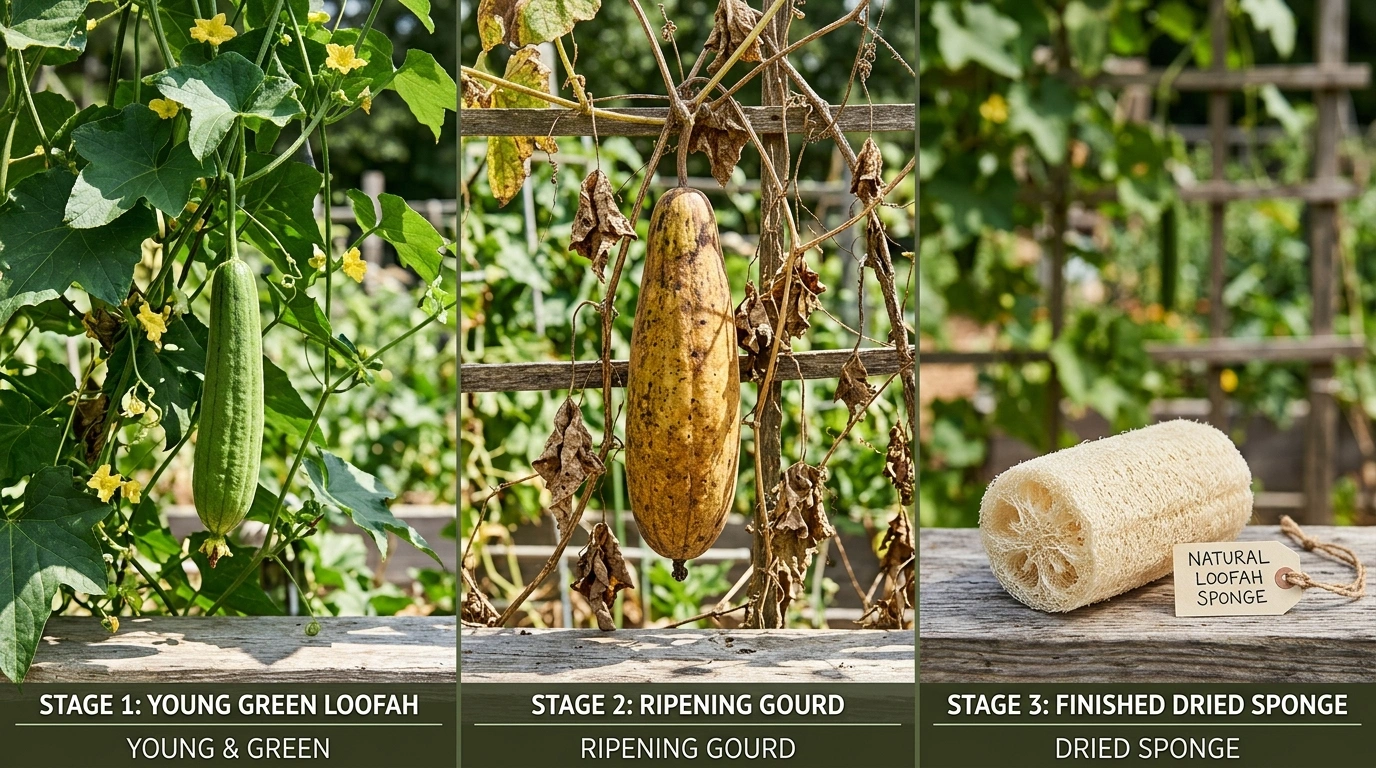
Few household items generate as much genuine confusion as the loofah. Ask a hundred people what a loofah actually is, and you will likely get a hundred slightly different answers. Some assume it is harvested from the ocean, confusing it with a sea sponge. Others know it comes from a plant but assume it is manufactured or synthetic. Others have eaten something called Chinese okra or silk squash without realizing it is the exact same plant that later becomes the sponge sitting in their shower.
The truth is that a loofah is, at different points in its life, accurately described as a plant, a vegetable, and a sponge, and understanding how those three identities fit together tells you almost everything you need to know about this surprisingly versatile organism.
The Direct Answer
A loofah is the fruit of a climbing vine in the cucumber and gourd family, scientifically classified under the genus Luffa. When picked young, it is a vegetable, tender, green, and edible, closely resembling a zucchini or cucumber. When left on the vine to fully mature and dry out, the same fruit transforms internally into a dense network of cellulose fibers, which becomes the loofah sponge used for exfoliation and scrubbing. At no point is it an animal or a synthetic product. It is a plant from beginning to end, simply presenting differently depending on when it is harvested.
Understanding the Plant Classification First
Botanically speaking, loofah belongs to the family Cucurbitaceae, the same family that includes cucumbers, zucchini, pumpkins, melons, and squash. This family is known for producing climbing or trailing vines with large leaves, tendrils for gripping support structures, and fruit that grows from pollinated flowers. Two species of loofah dominate cultivation worldwide. Luffa aegyptiaca, sometimes called smooth luffa or Egyptian luffa, produces a relatively smooth-skinned, cylindrical fruit. Luffa acutangula, commonly called ridged luffa or angled luffa, produces fruit with pronounced longitudinal ridges running along its length.
Both species follow the same general life cycle. Seeds germinate in warm soil, the vine grows rapidly and climbs using tendrils, yellow flowers bloom and are pollinated, and fruit develops from the base of the female flowers. This entire process, from seed to mature fruit, generally takes between ninety and one hundred fifty days depending on climate, variety, and growing conditions.
When Is a Loofah a Vegetable?

In its early growth stage, loofah fruit is unmistakably a vegetable in every practical sense. Harvested at four to eight inches in length, while the skin is still thin, tender, and easily pierced with a fingernail, young loofah is a genuine food crop eaten across large parts of Asia, Africa, and the Middle East.
In Chinese cuisine, it commonly appears under the name silk squash or si gua, often stir-fried with garlic, ginger, or eggs. In Indian and Pakistani cooking, it appears as turai or tori, frequently prepared in curries or lightly spiced sabzi dishes. In Vietnamese cuisine, it appears in soups. In Filipino cooking, it is a common ingredient in dishes like ginisang patola. In many Western grocery stores, particularly those serving Asian communities, it is sold under the label Chinese okra, despite having no botanical relationship to true okra.
At this vegetable stage, loofah has a mild, slightly sweet flavor and a texture similar to zucchini, though slightly spongier once cooked. It is a genuine, nutritious food source containing dietary fiber, vitamin C, and various micronutrients, and it plays a meaningful role in the culinary traditions of several regions where it has been cultivated for centuries.
When Does a Loofah Stop Being a Vegetable?
The transition from vegetable to sponge happens naturally if the fruit is simply left unharvested on the vine. As the fruit continues to mature past its edible window, its outer skin thickens, its color shifts from green to yellow to brown, and internal moisture gradually evaporates. Simultaneously, the internal structure of the fruit, which was previously soft and pulpy, hardens into a dense lattice of vascular fibers, the same fibers that carried water and nutrients through the growing fruit.
By the time the gourd is fully dry, it has become inedible, tough, and fibrous, and it rattles slightly when shaken due to the loose seeds inside. This is the exact point at which the fruit transitions from a food crop into a raw material for the sponge product most people are familiar with.
When Is a Loofah a Sponge?
Once the mature, dried gourd is harvested, it undergoes a simple processing sequence to become the familiar loofah sponge. The dried outer skin is peeled away, the seeds are shaken out and often saved for future planting, the remaining fiber skeleton is rinsed to remove any residual pulp, and the fiber is left to fully sun-dry before use or sale.
What remains after this process is a lightweight, durable, slightly abrasive network of plant fiber, entirely different in texture and function from the vegetable it started as, yet still composed of the exact same plant material. This fiber structure is what gives loofah its effectiveness as an exfoliating tool, since the interlocking fibers create just enough texture to lift dead skin cells without being sharp or damaging.
It is worth emphasizing that the sponge stage is not a separate species or variety. It is simply the fully mature, dried version of the identical plant sold as a vegetable earlier in its life cycle. A single loofah vine, depending entirely on when its fruit is harvested, can produce either food or bath sponges.
Why the Sea Sponge Confusion Persists
A significant portion of the ongoing confusion around loofah comes from its frequent mix-up with genuine sea sponges. Sea sponges are marine invertebrate animals belonging to the phylum Porifera, harvested from ocean beds rather than grown in soil. They share a broadly similar porous, absorbent texture with loofah, and both products have historically been sold in the same bath and body retail aisles, often under vague labeling like natural sponge, which does nothing to clarify the distinction.
This is not a trivial mix-up. Loofah and sea sponge come from entirely different biological kingdoms, plant versus animal, are harvested through completely different methods, agricultural cultivation versus ocean diving or dredging, and carry very different sustainability and ethical considerations. A loofah is a renewable, biodegradable plant crop that can be grown in a backyard garden in a single growing season. A sea sponge is a slow-growing marine organism harvested from natural reef or seabed ecosystems, raising different questions around ecological impact and harvesting practices.
Is a Loofah an Animal? Addressing the Myth Directly
To be unambiguous, no, a loofah is not an animal in any stage of its existence. It contains no animal cells, no animal protein, and no biological material derived from any creature. It is entirely composed of plant-based cellulose, the same structural material found in wood, cotton, and other plant fibers. Anyone avoiding animal products for ethical, dietary, or religious reasons can use natural loofah with complete confidence that it is a plant-derived product from start to finish.
Comparing Loofah to Its Cucurbitaceae Relatives
Understanding loofah’s place within its plant family helps clarify why it can serve such different purposes depending on harvest timing. Zucchini, another member of the Cucurbitaceae family, is almost always eaten young and tender, and rarely allowed to mature into a hardened state, since its mature form becomes tough and less palatable without developing the fibrous internal structure loofah does. Pumpkins and winter squash, by contrast, are intentionally left to fully mature on the vine, similar to how loofah is left to mature for sponge production, but their mature interior remains a dense, edible flesh rather than transforming into a fiber lattice.
Loofah is somewhat unique within this family because its fruit genuinely serves two distinct, useful purposes depending on when it is picked, a trait not shared by most of its closest relatives. This dual utility is part of why the plant has remained agriculturally significant across so many different cultures and culinary traditions for thousands of years.
The Fruit Versus Vegetable Distinction, Botanically Speaking
There is an additional layer of nuance worth addressing, one that applies to loofah just as it applies to tomatoes, cucumbers, and peppers. Botanically, loofah is technically classified as a fruit, since it develops from the ovary of a pollinated flower and contains seeds, which is the scientific definition botanists use to separate fruits from other plant structures like roots, stems, or leaves. Culinarily, however, loofah is treated and prepared as a vegetable, since it is savory rather than sweet and is used in cooking the way vegetables typically are, rather than being eaten raw as a sweet snack the way most fruits are.
This fruit versus vegetable distinction is not unique to loofah. Tomatoes, cucumbers, zucchini, eggplants, and bell peppers all share this same dual classification, botanically a fruit, culinarily a vegetable. Understanding this nuance helps explain why some botanical resources describe loofah as a fruit while nearly every cooking resource describes it as a vegetable. Both descriptions are accurate, they are simply using different classification systems for different purposes.
How Growing Conditions Influence the Plant’s Two Identities
The eventual identity of a loofah gourd, whether it ends up as food or as a sponge, is entirely a matter of grower intent rather than any difference in seed variety or growing method. A single seed packet of Luffa aegyptiaca can produce vines whose fruit is harvested young for the table, or left to mature fully for sponge production, or even split between the two purposes on the same vine.
Gardeners growing loofah specifically for culinary use will typically harvest continuously throughout the growing season to encourage the vine to keep producing new fruit, similar to how zucchini is harvested. Gardeners growing loofah for sponges will typically let some or all of the fruit remain on the vine through the end of the growing season, accepting a smaller total yield in exchange for fully matured, sponge-ready gourds.
This flexibility is one of the more appealing aspects of growing loofah at home, since a single planting can serve both purposes depending on how individual fruits are managed throughout the season.
Nutritional Profile of Loofah as a Vegetable
Since young loofah is a genuine food crop in many parts of the world, it is worth briefly covering its nutritional value. Young loofah is low in calories and fat, while offering a reasonable amount of dietary fiber, vitamin C, vitamin A, and several B vitamins, along with trace minerals like magnesium, manganese, and potassium.
It also contains a high water content, similar to cucumber or zucchini, which makes it a hydrating, light addition to soups, stir-fries, and curries. While it is not typically considered a nutritional powerhouse in the way leafy greens or cruciferous vegetables are, it fits comfortably into a balanced diet and has long been valued in traditional diets across Asia for its mild flavor and versatility in everyday cooking.
How to Tell Which Stage a Loofah Is At
For anyone growing their own loofah or simply curious about identifying the stage of a gourd, a few visual and physical cues make the distinction fairly easy. A vegetable-stage loofah is bright to medium green, firm but slightly yielding under gentle pressure, and has skin that can be pierced with a fingernail without much resistance.
A sponge-stage loofah is yellow to deep brown, feels notably lightweight for its size, has a papery or brittle outer skin, and often produces an audible rattle from loose seeds when shaken gently. Anything in between these two extremes is typically past its ideal eating window but not yet fully ready for sponge processing, a transitional stage most growers simply allow to continue maturing rather than harvesting.
A Simple Way to Remember the Three Identities
If it helps to simplify the concept, think of loofah’s life cycle in three clear stages. First, it is a plant, true throughout its entire existence, since every part of its life cycle, from seed to dried sponge, is entirely botanical in origin. Second, during its early growth window, it is accurately called a vegetable, since it is genuinely eaten as food in numerous cuisines. Third, once fully matured and processed, it becomes a sponge, used for skincare, household cleaning, and various other practical applications.
None of these three identities contradicts the others. They simply describe the same organism at different points along a single continuous life cycle, which is really the heart of why this question generates so much curiosity and occasional confusion.
Common Misconceptions Worth Clearing Up
A few related misconceptions tend to surface alongside the plant versus vegetable versus sponge question, and addressing them directly rounds out a complete understanding of the topic. Some people assume loofah sponges are manufactured or synthetic, perhaps because the finished product looks somewhat uniform and processed compared to a typical garden vegetable. In reality, aside from optional bleaching or trimming for cosmetic uniformity, the sponge is entirely unprocessed plant fiber, shaped naturally by the gourd itself rather than by any manufacturing process.
Others assume that loofah and zucchini or cucumber are essentially the same vegetable with different names, since young loofah does resemble both quite closely in appearance and texture. While all three do belong to the same broader plant family, they are distinct species with their own separate growing patterns, flavors, and, most notably, loofah’s unique capability to mature into a fibrous sponge, a trait its cucumber and zucchini relatives do not share in any comparable way.
Finally, some assume that because loofah can be eaten, any loofah sponge sitting on a store shelf could theoretically still be cooked and eaten if needed. This is not accurate. Once the fruit has fully matured and dried into its fibrous sponge state, the transformation is irreversible, and the result is genuinely inedible, having lost the soft, moisture-rich pulp that made the young vegetable palatable in the first place.
No. By the time a loofah has matured into the dried, fibrous sponge form, it is no longer a living plant. The growing, living stage ends once the fruit fully dries on the vine.
Frequently Asked Questions
Is a loofah alive when you buy it as a sponge?
No. By the time a loofah has matured into the dried, fibrous sponge form, it is no longer a living plant. The growing, living stage ends once the fruit fully dries on the vine.
Can you eat the loofah you use in the shower?
No. Once a loofah gourd has matured into the fibrous sponge stage, it is too tough, dry, and fibrous to be edible or palatable. Only the young, immature fruit is suitable for eating.
Is loofah closer to a fruit or a vegetable botanically?
Botanically, loofah is technically a fruit, since it develops from a pollinated flower and contains seeds, which is the scientific definition of a fruit. Culinarily, however, it is treated and prepared as a vegetable, similar to how tomatoes, cucumbers, and zucchini are botanically fruits but culinarily categorized as vegetables.
Why do some people think loofah is a sea creature?
The confusion stems largely from loofah’s textural and functional similarity to genuine sea sponges, combined with vague retail labeling that has historically grouped both products together as generic natural sponges.
Does the plant look different depending on whether it will be eaten or turned into a sponge?
No. The plant and its fruit look identical in early growth regardless of its eventual use. The only difference is entirely a matter of harvest timing, not variety or growing method.
Can one loofah plant produce both food and sponges?
Yes. Since the outcome depends entirely on when individual fruits are harvested, a single vine can produce some fruit picked young for eating and other fruit left to mature fully into sponges.