

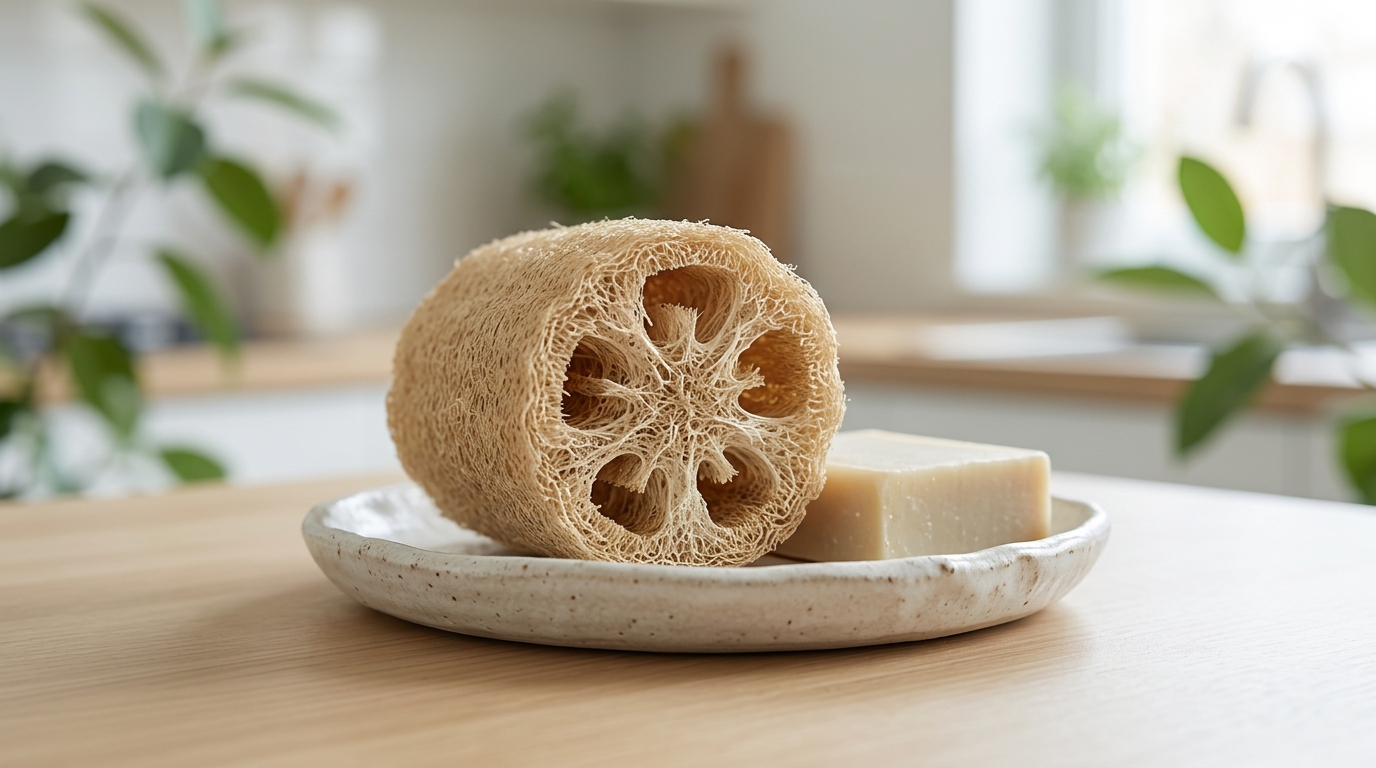
Standard yellow-and-green foam scrubbers shed microplastics down your drain every time you scrub a greasy pan. Over a single year, a standard household discards roughly 24 synthetic sponges that linger in landfills for centuries. Replacing plastic scrubbers with a natural alternative stops synthetic pollution at your kitchen sink without sacrificing scrubbing power.
A natural loofah dish sponge solves dishwashing waste by swapping synthetic polyurethane for dried botanical fibers derived from mature gourd plants. When dry, these interconnected plant fibers feel rigid and coarse, but soaking them in warm water expands the structure into a flexible, porous scrubbing pad. The resulting texture creates rich soap lather while lifting hardened grease and food residue from delicate cookware surfaces. Because the fibrous network allows rapid airflow between uses, the material dries faster than dense polyurethane foams, reducing trapped moisture where food particles usually rot. Transitioning to a plant-based kitchen tool lowers personal plastic footprints and provides a fully home-compostable cleaning habit that enriches soil rather than clogging waterways.
What Is a Loofah Dish Sponge and How Is It Made?
A loofah dish sponge originates from the dried fibrous interior of mature gourds in the cucumber and squash family. Unlike ocean sponges derived from marine animals, these cleaning tools grow on terrestrial vines requiring sunlight, warm climates, and rich soil. You can learn more about
The manufacturing process requires minimal industrial processing and zero petroleum inputs:
-
Harvesting occurs in autumn after the green vine turns yellow and the outer gourd skin dries into a hard shell.
-
Farmers peel the dry outer skin to expose the dense network of fibrous vascular tissue inside the fruit.
-
Soaking the core in water removes seeds, pulp, and residual sap from the internal channels.
-
Sun drying hardens the cellulose fibers into lightweight, stiff cylinders ready for cutting.
-
Factories cut the dried cylinders into flat pads, oval slices, or stitched multi-layer scrubbing sponges.
According to botanical taxonomists studying the
Plant Species Used in Natural Kitchen Sponge Production
Two primary species produce commercial loofah materials across global agricultural networks:
-
Luffa aegyptiaca (smooth loofah): Features dense, interconnected inner networks ideal for heavy-duty scrubbing pads.
-
Luffa acutangula (angled loofah): Yields softer, less dense fiber networks often selected for delicate glassware cleaning.
Understanding how botanical structure translates into kitchen utility helps households select the proper fiber density for daily pot scrubbing. Discovering whether a
Why Should You Replace Synthetic Kitchen Sponges with Loofah?
Switching to a loofah dish sponge eliminates microplastic shed at the source while delivering natural scrubbing texture across kitchen surfaces. Traditional yellow foam sponges consist of polyurethane plastic bonded to a polyester scrub pad, releasing thousands of plastic fragments into municipal wastewater systems each week.
The Problem with Synthetic Foam Scrubbers
Plastic sponges deteriorate rapidly under heavy friction, breaking into microscopic fragments that pass through water treatment facilities.
-
Microplastics enter aquatic ecosystems, absorbing toxins and entering marine food chains.
-
Synthetic open-cell foam traps damp food debris, encouraging rapid bacterial colonies within 48 hours.
-
Used plastic scrubbers cannot undergo recycling and accumulate indefinitely in municipal landfills.
-
Chemical dyes and synthetic binders leak into wastewater during high-temperature dishwashing cycles.
The Environmental Advantage of Botanical Fibers
Plant-based kitchen scrubbers reverse these ecological drawbacks through natural biological degradation:
-
Zero microplastic shedding during aggressive pot scrubbing or hot water soaking.
-
Complete breakdown in home compost bins within four to six weeks of disposal.
-
Agricultural production captures carbon dioxide during the crop growing season.
-
Renewable annual harvests replace petroleum extraction required for synthetic foam production.
Scientific evaluations published in
How Does a Natural Loofah Dish Sponge Perform on Tough Grease?
A loofah dish sponge handles tough grease and baked-on food remnants through mechanical fiber stiffness without scratching sensitive cookware surfaces. When dry, botanical fibers feel rough, but contact with hot water softens the cell walls, transforming the sponge into an adaptable cleaning tool.
DRY FIBERS (Rigid, Coarse) ──> HOT WATER SOAK ──> SOFTENED MATRIX (Flexible, Abrasive)
The course fibers lift cooked starches and scorched sauces while allowing water to flush debris straight through the open network.
Performance Across Common Kitchen Surfaces
Different cookware materials react uniquely to abrasive cleaning tools:
-
Cast iron: Scrapes away charred food bits without removing seasoned oil layers.
-
Non-stick ceramic: Safely removes grease without scratching delicate PTFE or ceramic non-stick coatings.
-
Stainless steel: Lifts scorched oil rings while restoring surface shine without wire-mesh scratches.
-
Glassware and porcelain: Softens enough under warm water to polish delicate wine glasses without clouding.
Lather Generation and Dish Soap Conservation
The open structural network creates rich soap suds using small amounts of liquid soap or solid dish soap bars. Because air circulates freely through the matrix, pumping the sponge generates thick foam that suspended grease molecules quickly.
Are Loofah Dish Sponges Hygienic for Daily Kitchen Use?
A loofah dish sponge maintains high hygiene levels in the kitchen due to its rapid drying rate and porous structure. Traditional polyurethane sponges retain water deep inside closed cells, creating dark, moist environments where bacteria multiply.
According to research detailed in
Four Steps to Sanitize Your Botanical Sponge
Maintaining clean kitchen tools requires simple weekly sanitization habits:
-
Rinse out all residual soap and food particles under running warm water after finishing dishes.
-
Wring out excess moisture thoroughly using a firm squeeze without twisting the fiber bindings.
-
Microwave the damp loofah pad on high for 60 seconds, or submerge it in boiling water for 3 minutes.
-
Hang the clean sponge in a well-ventilated location using a dedicated hanging loop.
Odor Control and Drying Best Practices
Bacteria flourish when sponges remain wet on flat counter edges. Elevating your cleaning tool on a dry rack or hanging it from a faucet hook allows air to flow through the top and bottom simultaneously.
-
Never leave a damp plant sponge sitting inside a wet sink basin.
-
Squeeze, do not wring, to maintain structural shape and prevent torn fiber seams.
-
Replace the sponge immediately if fibers become soft, mushy, or retain persistent sour smells after boiling.
Understanding the difference between raw botanical terms like
How Do You Choose, Use, and Care for a Loofah Dish Sponge?
Selecting the right loofah dish sponge depends on your household washing habits, cookware types, and storage setup. Natural plant scrubbers come in flat cut sheets, multi-layer stitched pads, and combination cellulose-loofah designs.
Types of Plant-Based Kitchen Scrubbers
Selecting the ideal format improves efficiency at the sink:
-
Single-layer flat loofah: Flexible sheet ideal for reaching into narrow cup bottoms and mug corners.
-
Stitched multi-layer loofah: Thick compressed pad offering extra firmness for heavy-duty pot scrubbing.
-
Dual-sided loofah and cellulose: Combines a soft wood-pulp backing for wiping counters with a loofah face for scrubbing.
Daily Step-by-Step Usage Guide
Maximizing the useful life of your natural scrubber involves basic steps during washing sessions:
-
Expand: Submerge a new, compressed loofah in warm water for 3 minutes until fibers expand completely.
-
Soap application: Apply a small drop of concentrated liquid dish soap or rub directly on a solid dish block.
-
Wash: Scrub dishes using circular motions, allowing coarse fibers to lift food without excessive muscle pressure.
-
Rinse: Flush running water through the open fiber matrix until all soap bubbles vanish.
-
Dry: Hang by a cotton loop in an airy spot away from stagnant water splashes.
For households interested in agricultural origins, exploring
Comparing Kitchen Scrubber Materials: Loofah vs Synthetic vs Cellulose
Understanding how a loofah dish sponge compares to alternative materials clarifies why plant fiber excels in modern kitchens. Each material option exhibits unique trade-offs in durability, environmental impact, and cleaning performance.
Material Comparison Matrix
While silicone scrubbers last longer, their smooth bristles lack the abrasive texture required to scrub baked-on sheet pans. Cellulose sponges excel at wiping up counter spills but lack the structural body to tackle burnt grease without added plastic abrasive layers.
Combining loofah for heavy scrubbing with pure cellulose for wiping water spills creates a zero-waste cleaning system across kitchen counters.
How Do Loofah Sponges Support a Zero-Waste Kitchen Strategy?
Integrating a loofah dish sponge into your home routines advances sustainable living by removing single-use plastic waste from the kitchen. True zero-waste habits rely on closed-loop lifecycles where items return to the earth as organic matter.
PLANT GOURD ──> HARVEST & DRY ──> SCRUB DISHES ──> HOME COMPOST ──> GARDEN SOIL
End-of-Life Disposal and Composting
When your plant scrubber breaks down after weeks of washing, disposal requires no special waste management services:
-
Cut the worn loofah into smaller 1-inch strips using kitchen shears to accelerate decomposition.
-
Toss the fiber strips into your outdoor compost tumbler, vermicomposting bin, or municipal green bin.
-
Nitrogen-rich soil bacteria digest the natural cellulose matrix within 30 to 45 days.
-
Rich compost feeds home gardens, nourishing future plant growth in a closed loop.
Cost Efficiency Over Time
Purchasing natural plant scrubbers in multi-packs lowers per-unit costs below standard brand-name synthetic sponges. Because dried loofah stores indefinitely when kept dry, buying in bulk provides years of plastic-free scrubbing supplies without product degradation.
Visiting dedicated resources on
Frequently Asked Questions
How long does a natural loofah dish sponge last in the kitchen?
A single plant sponge lasts four to six weeks under normal daily dishwashing conditions. Rinsing thoroughly after each use and hanging the fibers to dry between dish loads maximizes durability and prevents fiber breakdown.
Will a loofah scratch non-stick pans or delicate glassware?
No, natural loofah fibers soften when exposed to warm water, making them safe for non-stick ceramic, stainless steel, and glass. Test the softened fiber gently on a small area first when cleaning ultra-delicate decorative glassware.
Can you wash a loofah dish sponge in the dishwasher?
Yes, placing your plant sponge on the top rack of a dishwasher cycle sanitizes the fibers using hot water and steam. Allow the loofah to air-dry fully after the wash cycle finishes.
How do you dispose of a worn-out loofah kitchen sponge?
Cut the old sponge into small pieces and place them directly into your home compost bin or outdoor pile. The 100% plant fibers break down into nutrient-rich soil matter within a few weeks.
Conclusion
Transitioning to a natural loofah dish sponge represents a straightforward, practical step toward eliminating kitchen microplastics without compromising on cleaning performance. By swapping synthetic foam scrubbers for renewable botanical fibers, you keep plastic waste out of municipal landfills and protect aquatic environments from microplastic pollution. These durable plant-based pads soften in hot water, cut through tough pan grease safely, and air-dry quickly to maintain everyday sink hygiene. When your sponge reaches the end of its useful lifespan, cutting it into your home compost pile completes a circular, zero-waste loop. Take charge of your daily sink routine today by swapping out synthetic scrubbers for compostable plant alternatives on your next supply restock.